In January, Adam Weitsman approached ACK for a commission with two conditions: complete creative freedom, and that it be his best work to date. ACK went to work the next day.
For months he pursued an idea, certain of what it would become. It never got there. When that finally became undeniable, he stepped away from the scene altogether and sat with the loss of it.
A few weeks later, not looking for anything, it found him while he was watching Dune. He stopped on a single frame: Shai-Hulud worked in gold across a great paneled wall, and beneath it Paul Atreides, the Kwisatz Haderack, dwarfed by the entity he was always meant to discover.
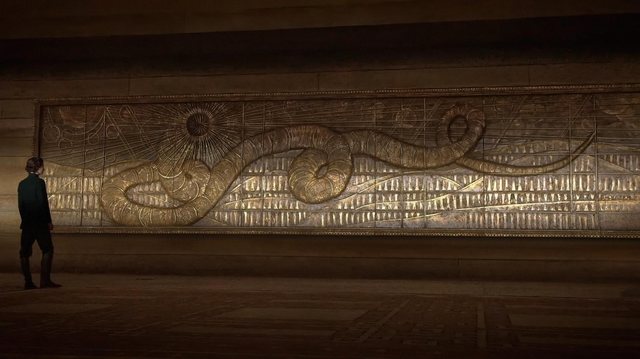
What held him was the gravity of it. The ornaments, the stars, the sand, and above all the isolation. Nothing in the panel would dare pull your eye from it. He knew that feeling, of standing small before the thing you were always meant to find. This was what he needed to make, and so the search for Bösendorfer began.
The path came clear only after hundreds of hours of iteration in ZBrush, Blender, and Cinema 4D. What surfaced did not feel invented. It felt uncovered, a fossil from a museum that does not exist yet, in a place that is not here, drawn from the bones of a Bösendorfer grand, gold and ivory set into cracked obsidian.
ACK has said the creature brought itself into being, and that he was only honored to play a part in it.
It was rendered thirty thousand pixels wide at three hundred dots per inch, engineered to stand twenty feet wide and eight feet tall. It will be printed on a swissQprint Kudu flatbed press in ChromaSculpt, ACK's signature technique of deep textured inks and spot varnishing, finished on brushed aluminum, and placed permanently at the Carl Sagan Art Residence.